Friday, March 30, 2007
Falcon 1 is Operational
SpaceX has declared the Falcon 1 operational and ready for missions. This comes after analysis of the Demo Flight 2 last week.
US Military wants Space Based Interceptors
The US Military has asked congress for $10 million to study the use of space based interceptors to augment the missile defense program.
Lieutenant General Trey Obering, head of the MDA, told the House Armed Services Committee
missile defense "could be greatly enhanced" by adding space-based interceptors.
Lieutenant General Trey Obering, head of the MDA, told the House Armed Services Committee
missile defense "could be greatly enhanced" by adding space-based interceptors.
Rocketplane/Kistler to Asymbel COTS Vechicle in New Orleans
Rocketplane Kistler, Inc. has a Space Act Agreement (SAA) with Marshall Space Flight Center to use the Michoud Assembly Facility (MAF) in New Orleans, LA for the assembly of the K-1 Space Transportation System.
There are Plenty of Twin-Star Systems
The NASA Spitzer Telescope has discovered that twin-star systems, including dusty disks of asteroids, comets and possibly planets, are as numerous as normal one star systems.
It has been know that planets could form around wide binary stars, 1000 AUs apart, but this new study shows stars that are between 0 and 500 AUs seem to have no problem forming planetary disks.
It has been know that planets could form around wide binary stars, 1000 AUs apart, but this new study shows stars that are between 0 and 500 AUs seem to have no problem forming planetary disks.
FAA to Issue Experimental Permit Regulations
The FAA is expected to issue "experimental permits regulations" in the next few weeks. The permits are designed to allow private space companies to test their rockets in anticipation of providing tourists services to the general public in the next few years.
The regulations are not expected to be very strict, allowing the infant industry to test and experiment as much as they need to. However, tourists will not be allowed on the test flights.
The regulations are not expected to be very strict, allowing the infant industry to test and experiment as much as they need to. However, tourists will not be allowed on the test flights.
China's Lunar Probe to Complete Four Missions
China's first Lunar probe "Chang'e 1" has a plan to complete four missions.
Chang'e 1's first mission is to obtain 3D images of the lunar surface. Its second task is to analyze the distribution of 14 useful elements and materials below the lunar surface. The third job of the lunar probe is to assess the thickness of the lunar soil and reserves of helium-3 resources. The fourth task is to explore the space environment 400,000 kilometers away from the moon, obtain data about solar winds, and study the impact of solar activity on the space environment between the earth and the moon.
Thursday, March 29, 2007
China and Russia to Explore Mars
China and Russia are getting together to send a probe to Mars and one of it's moons in 2009.
NASA Multi-program Schedule
This schedule (pdf) includes milestones for the Space Shuttle, Soyuz, Progress, ATV, HTV, COTS (including Rocketplane/Kistler and SpaceX), Ares 1, and Orion flights between 2007 and 2015. Interesting stuff.
Virgin Galactic and NASA to work on Hypersonic Plane
Virgin Galactic and NASA worked out an agreement to work on a hypersonic plane that can go as fast as Mach 5, making a trip from New York to LA about 45 minutes.
Wednesday, March 28, 2007
India Begins Assembly of Moon Probe
Assembly of the Chandrayaan-I craft, India's first unmanned mission to the moon, has begun. The probe is scheduled to launch in spring 2008.
SpaceDev Wins Operationally Responsive Space Payload Development Contract
SpaceDev was awarded the an Operationally Responsive Space Payload Development contract from the Naval Research Laboratory (NRL). The contract is for Combined Optical, Radio, Radar Instrument (CORRI), designed for a small satellite payload application.
SpaceDev Earnings Report
SpaceDev has set the date for their earning report conference call to April 4, 2007.
SpaceDev, Inc. (OTC BB:SPDV.OB - News) will host a conference call to discuss its 2006 financial results on Wednesday, April 4, 2007, at 1:00 p.m. EDT. The Company expects to file its annual report on Form 10-KSB with the Securities and Exchange Commission on Monday, April 2, 2007 and issue a related press release on its financial results on Tuesday, April 3, 2007.
SpaceDev, Inc. (OTC BB:SPDV.OB - News) will host a conference call to discuss its 2006 financial results on Wednesday, April 4, 2007, at 1:00 p.m. EDT. The Company expects to file its annual report on Form 10-KSB with the Securities and Exchange Commission on Monday, April 2, 2007 and issue a related press release on its financial results on Tuesday, April 3, 2007.
SpaceX Falcon 1 and Dragon Update
Elon has posted a new update on the Falcon 1 Demo flight.
Flight Global has more on the Dragon capsule.
Flight Global has more on the Dragon capsule.
Astronomers Find Four New Planets
Three new gas giants and one Neptune size (that's a first.) This brings the total count to 204.
Sharper Image to Sell Zero-G Flights
Sharper Image has signed an agreement with Zero-G to sell tickets to public flights. Zero-G is the only FAA approved public supplier of "weightless" flights.
[update 12:07 pm CST: Had the wrong link. Fixed now -djs]
[update 12:07 pm CST: Had the wrong link. Fixed now -djs]
Boeing to Bid on the CLV Upper Stage
Boeing is leading a team hopping to build the upper stage for the CLV.
Tuesday, March 27, 2007
Genesis II is off to Russia
From Bigelow Aerospace:
Las Vegas, NV 03/27/07 – Bigelow Aerospace announces its second pathfinder space complex module Genesis II has been shipped to a launch site in Russia and is expected to be lofted into orbit in mid-April.
Genesis II will be enclosed in a payload shroud and put atop a Dnepr rocket at the ISC Kosmotras Space and Missile Complex near Yasny, Russia for a launch window that begins on April 19.
If it successfully reaches orbit, Genesis II will mark the second test flight for a Bigelow Aerospace module following the successful start to the Genesis I mission last July. It is not meant for habitation and will launch into an orbit separate from Genesis I.
The outside appearance and size of the new module will be identical to Genesis I — approximately 15 feet (4.4 meters) in length and 6.2 feet (1.9 meters) in diameter, expanding to 2.54 meters (eight feet) in diameter once in orbit. It is a one-third scale version of the manned commercial space modules Bigelow Aerospace hopes to launch in the future.
Unlike the company’s previous spacecraft, Genesis II will feature several systems and materials not flown on Genesis I. This includes upgrades to vehicle control and sensors, a multi-tank inflation system for the module’s expansion and additional layers to the module’s outer shielding. There will also be a total of 22 combined interior and exterior cameras on Genesis II that include articulated and wireless cameras, as well as an exterior projection system to allow the display of images on the main body of the vehicle.
Genesis II features items and pictures sent up by paying customers are part of the “Fly Your Stuff” program. The photos and items will be photographed and displayed on the Bigelow Aerospace Website at www.bigelowaerospace.com.Public participation will also include the first-ever “Space Bingo” game, as well as the Biobox life sciences experiment featuring colonies of ants, scorpions and cockroaches.
The public is invited to follow the preparations for the start of the Genesis II mission through an ongoing blog by company counsel Mike Gold on the Bigelow Aerospace Website at www.bigelowaerospace.com.Posts From Yasny Launch Base
From Bigelow Aerospace:
A team from Bigelow Aerospace has arrived at the ISC Kosmotras Space and Missile Complex near Yasny, Russia in preparation for the launch. To keep everyone up to date on the lead-up to liftoff, Bigelow Aerospace counsel Mike Gold is writing a series of posts from Yasny describing what is hoped to be the beginning of our next great adventure.
Virgin Galactic and New Mexico Reach Pact
New Mexico and Virgin Galactic have reached a pact on the use of Spaceport America. Virgin Galactic will pay $27.5 million over 20 years to lease launch facilities in southern New Mexico. New Mexico hopes to fund the spaceport with a property tax increase in Dona Ana County, the location of Spaceport America.
Photos of the HMP Research Station
The HMP Research Station on Devon Island has released some aerial photos of the compound.
Closer to Star Wars
John Pangia talks about how new space companies are getting us closer to Han Solo.
More on New Mexico Spaceport Referendum
Here is Aly Adair's opinion on the upcoming vote to raise taxes in Dona Ana County New Mexico to fund Spaceport America.
ESA to Launch ATV this Fall
The ESA says they plan to launch the ATV, or Automated Transfer Vehicle, this fall. This is a few months later than originally planned. The ATV is designed to ferry supplies to the ISS.
Monday, March 26, 2007
New Genesis Photos
Bigelow Aerospace has three new photos of the Genesis 1 inflatable module currently in orbit around the Earth.

Rocketplane/Kistler to Shuttle Poeple for Bigelow in 2012
Rocketplane/Kistler announced that they have signed a letter-of-intent with Bigelow Aerospace to carry passengers to Bigelow's coming orbital station by 2012. The announcement was made by George French III, son of the Chairman and CEO.
Update On Bigelow Aerospace's Genesis 2
Here is an update on all the updates to the upcoming successor to Genesis, Genesis 2.
Apparently ITAR is getting even worse:
While Bigelow Aerospace is making strides in the development of its modules, one ongoing headache is the export control and regulatory process, be it International Traffic in Arms Regulations (ITAR) or telemetry issues, Gold said. “If anything, the regulatory procedures have been more difficult for Genesis 2 than Genesis 1. It rivals, if not exceeds, the technological difficulties that we face.”
Here is another teaser from next months announcement at the National Space Symposium:
Bigelow said the business structure that the company will outline next month will not only support destinations in low Earth orbit, but also operations on the Moon and at Mars.
Apparently ITAR is getting even worse:
While Bigelow Aerospace is making strides in the development of its modules, one ongoing headache is the export control and regulatory process, be it International Traffic in Arms Regulations (ITAR) or telemetry issues, Gold said. “If anything, the regulatory procedures have been more difficult for Genesis 2 than Genesis 1. It rivals, if not exceeds, the technological difficulties that we face.”
Here is another teaser from next months announcement at the National Space Symposium:
Bigelow said the business structure that the company will outline next month will not only support destinations in low Earth orbit, but also operations on the Moon and at Mars.
Citizens of New Mexico Vote on the Future
The Citizens of Las Cruces and surrounding Dona Ana County in New Mexico are voting April 3 on whether or not to increase their property taxes in order to fund Spaceport America. Governor Bill Richardson(D) and his staff has plans for an inland spaceport that will be the home of Starchaser as well as one of the launch sites of Virgin Galactic.
All I can say is, choose your future wisely Las Cruces.
All I can say is, choose your future wisely Las Cruces.
SpaceX Demo Flight 2 Updates
Here is China's take on SpaceX:
Space Exploration Technologies, or SpaceX, is offering the rocket, as well as an untested heavy-lift booster, for sale at about one-fifth current market rates.
So for the curious here is what happened:
SpaceX CEO Elon Musk has noted that the preliminary assessment of the Falcon I flight shows that the second stage shut down only a minute before schedule - and still managed to deploy its satellite mass simulator ring.
The shutdown appears to have been caused by the sloshing of propellant in the LOX tank, increasing observed oscillation, which would normally have been successfully dampened out by the second stage Thrust Vector Control (TVC) system. However, the impact on the second stage nozzle during separation caused a 'hard slew' correction, over-compensating previously simulated
Space Exploration Technologies, or SpaceX, is offering the rocket, as well as an untested heavy-lift booster, for sale at about one-fifth current market rates.
So for the curious here is what happened:
SpaceX CEO Elon Musk has noted that the preliminary assessment of the Falcon I flight shows that the second stage shut down only a minute before schedule - and still managed to deploy its satellite mass simulator ring.
The shutdown appears to have been caused by the sloshing of propellant in the LOX tank, increasing observed oscillation, which would normally have been successfully dampened out by the second stage Thrust Vector Control (TVC) system. However, the impact on the second stage nozzle during separation caused a 'hard slew' correction, over-compensating previously simulated
Saturday, March 24, 2007
Supply Chain Management in Space
A group from MIT has developed a program called SpaceNet that models an interplanetary supply chain that could be used once we have a permanent base in either the Moon, Mars, or in Orbit.

Space Access 2007
If you didn't know, Space Access 2007 has been going on this week. There are several bloggers there, including:
http://www.transterrestrial.com/
http://spacepolitics.com/
http://www.hobbyspace.com/nucleus/index.php
http://whyhomeschool.blogspot.com/2007/03/space-access-07-introduction.html
Some neat stuff going on...
http://www.transterrestrial.com/
http://spacepolitics.com/
http://www.hobbyspace.com/nucleus/index.php
http://whyhomeschool.blogspot.com/2007/03/space-access-07-introduction.html
Some neat stuff going on...
Friday, March 23, 2007
Ares to Asteroids
NASA is considering using the same hardware that carries astronauts to the moon to carry the first humans to asteroids.
NASA Drops Scale Model of Orion
NASA dropped the a scale model of the proposed capsule for manned travel to the Moon, Orion.
NASA Puts off Shuttle Launch Decision Until April
NASA won't reschedule the launch of Atlantis in mission STS-117 until April. The Launch could be pushed off in May or as late as June.
SpaceX Confirms Stage Bump
Today, SpaceX confirmed that when Stage 1 separated from their Falcon 1 demonstration launch, it bumped the stage 2 engine. However, he said "Yes, the stage sep bump will obviously need to be addressed, however it does not appear to have caused damage."
It has been conjectured by many that this was the cause of the rapid oscillation of the second stage just before telemetry was lost. It is still unclear as to what caused the second stage engine to stop early. But there is good news:
They were also unable to recover the first stage because of an error with the GPS module.
There will be an update on SpaceX.com next week.
It has been conjectured by many that this was the cause of the rapid oscillation of the second stage just before telemetry was lost. It is still unclear as to what caused the second stage engine to stop early. But there is good news:
"We had some blips in telemetry, but were able to obtain a data feed for almost the entire flight time. The stage rotation caused the signal/noise to vary from strong to weak, as the antenna position changed and the distance from the receiving dish increased. However, with some additional work, we managed to reconstruct almost all the data."
They were also unable to recover the first stage because of an error with the GPS module.
There will be an update on SpaceX.com next week.
Thursday, March 22, 2007
Top 25 Sci-Fi Movies
Robot Guy has his list of to 25 Movies so I am jumping on the bandwagon with both feet.
BTW: I am using my own definition of what makes Sci-Fi and what makes a movie, if you don't agree with it, it's my show, my rules.
1. Serenity (was there any doubt)
2. The Fifth Element
3. Matrix (on the 1st one)
4. I-Robot
5. Treasure Planet
6. Star Trek First Contact
7. Battlestar Galactica the Mini Series (I count it as a movie)
8. Return of the Jedi
9. Back to the Future
10. Star Wars
11. Back to the Future III
12. Empire Strikes Back
13. Back to the Future II
14. Star Trek Insurrection
15. Star Trek Generations
16. Star Trek Nemesis
17. X-Men
18. Star Trek IV
19. X-Men II
20. Men in Black
21. Star Trek VI (Shields, I said Shields!)
22. The Last Star Fighter
23. Star Trek III
24. Star Trek II
25. Star Trek V
BTW: I am using my own definition of what makes Sci-Fi and what makes a movie, if you don't agree with it, it's my show, my rules.
1. Serenity (was there any doubt)
2. The Fifth Element
3. Matrix (on the 1st one)
4. I-Robot
5. Treasure Planet
6. Star Trek First Contact
7. Battlestar Galactica the Mini Series (I count it as a movie)
8. Return of the Jedi
9. Back to the Future
10. Star Wars
11. Back to the Future III
12. Empire Strikes Back
13. Back to the Future II
14. Star Trek Insurrection
15. Star Trek Generations
16. Star Trek Nemesis
17. X-Men
18. Star Trek IV
19. X-Men II
20. Men in Black
21. Star Trek VI (Shields, I said Shields!)
22. The Last Star Fighter
23. Star Trek III
24. Star Trek II
25. Star Trek V
Wednesday, March 21, 2007
New Mexico Spaceport to Cost Less
New Mexico's Spaceport America is coming in below estimates. Early estimates were $225 million and the number now looks to be closer to $195 million with $3.96 million having already been spent.
Fly With Stephen Hawkings on Zero-G
The Starlight Starbright Children’s Foundation is auctuioning tickets to be on the same Zero-G flight as Professor Stephen Hawkings. The auction is taking place on E-Bay. Here is the release:
Experience history in the making with an amazing opportunity to join Professor Stephen Hawking, the world-renowned physicist and expert on gravity, as he realizes his life-long dream of floating weightless aboard a specially modified plane known as The ZERO-G Experience™ on April 26, 2007 launching from the Kennedy Space Center in Central Florida.
The experience will be auctioned on eBay from March 16th through March 26th. All proceeds raised through this auction will benefit Starlight Starbright Children's Foundation.
The once-in-a-lifetime auction package includes two tickets aboard the Zero-G, zero-gravity flight with Hawking as well as a dinner and lecture with Hawking. Hotel accommodations for three nights are provided through JW Marriott Hotel Grande Lakes in Orlando, Florida.
Visit www.ebay.com/flywithhawking and get bidding!
For more information on the Zero Gravity Corporation visit www.GoZeroG.com. For more information on Starlight Starbright Children’s Foundation visit Starlight Starbright.
Experience history in the making with an amazing opportunity to join Professor Stephen Hawking, the world-renowned physicist and expert on gravity, as he realizes his life-long dream of floating weightless aboard a specially modified plane known as The ZERO-G Experience™ on April 26, 2007 launching from the Kennedy Space Center in Central Florida.
The experience will be auctioned on eBay from March 16th through March 26th. All proceeds raised through this auction will benefit Starlight Starbright Children's Foundation.
The once-in-a-lifetime auction package includes two tickets aboard the Zero-G, zero-gravity flight with Hawking as well as a dinner and lecture with Hawking. Hotel accommodations for three nights are provided through JW Marriott Hotel Grande Lakes in Orlando, Florida.
Visit www.ebay.com/flywithhawking and get bidding!
For more information on the Zero Gravity Corporation visit www.GoZeroG.com. For more information on Starlight Starbright Children’s Foundation visit Starlight Starbright.
NASA Shutting Down the Institute for Advanced Concepts
NASA is closing the Institute for Advanced Concepts which develops advanced ideas on the bleeding edge of technology for space travel.
Good move guys, cut down one of the few parts of NASA that is doing what NASA should be doing.
Good move guys, cut down one of the few parts of NASA that is doing what NASA should be doing.
B612 Foundation Believes NASA can Defect Nearth Earth Objects with Current Budget
The B612 Foundation has written a report on how to devert a NEO and points out the difference with to NASA's 2006 Near-Earth Object Survey and Deflection Study.
They believe that a Gravity Tractor or Kenetic Impactor on the scale of the Deep Space 1 mission, which cost NASA ~$150 million, could handle 98% of NEO cases.
They believe that a Gravity Tractor or Kenetic Impactor on the scale of the Deep Space 1 mission, which cost NASA ~$150 million, could handle 98% of NEO cases.
The GT concept, as presented in NASA's NEO Workshop held in Vail, Colorado in June-July 2006, is adaptable to any size spacecraft and was specifically presented and evaluated in White Paper 42 (the only professional paper presented on the gravity tractor) based on NASA's Deep Space 1 spacecraft flown successfully from 1998-2000 and costing (based on the official NASA website, http://nmp.nasa.gov/ds1/quick_facts.html) $149.7 million (FY 95-99). Given that the presentations at NASA's Vail Workshop explicitly presented and evaluated the GT concept based on the Deep Space 1 mission technology, and not on the cancelled Prometheus, it is mystifying why, in NASA's Report to Congress the GT was presented as technically immature and extremely costly.
Nowak to Face Trial as Early as July
Former astronaut Lisa Nowak, who was arrested on charges of attempted kidnapping of a romantic rival, could face trail as early as July. The trial will be set in Florida, where Nowak confronted her "rival" for the affections of another astronaut. The State Attorney's office said the trial has been scheduled for July 30 and should last two weeks.
Final Update on SpaceX Falcon 1 Launch
So here is the analysis from SpaceX:
The following technology risks were proved out:
- 1st stage ascent past max dynamic pressure
- avionics operation in vacuum and under radiation
- stage separation
- 2nd stage ignition
- fairing separation
- 2nd stage nozzle/chamber at steady state temp in vacuum
Also the Falcon made it to approximately 200 miles, 50 miles below the International Space Station. Due to the as yet unexplained roll in the second stage, it did not achieve full orbital velocity.
SpaceX believes the flight demonstrated 95% of the Falcon 1 systems, which are reused in the Falcon 9 being developed for larger launches and NASA's COTS program.
SpaceX has two more launches of the Falcon 1 scheduled for 2007. A US military satellite and a Malaysian satellite are set for this summer and fall. Pricing for the Falcon 1 is set at $7 million, which is a 1/10th the cost of the nearest competitor.
Links:
The following technology risks were proved out:
- 1st stage ascent past max dynamic pressure
- avionics operation in vacuum and under radiation
- stage separation
- 2nd stage ignition
- fairing separation
- 2nd stage nozzle/chamber at steady state temp in vacuum
Also the Falcon made it to approximately 200 miles, 50 miles below the International Space Station. Due to the as yet unexplained roll in the second stage, it did not achieve full orbital velocity.
SpaceX believes the flight demonstrated 95% of the Falcon 1 systems, which are reused in the Falcon 9 being developed for larger launches and NASA's COTS program.
SpaceX has two more launches of the Falcon 1 scheduled for 2007. A US military satellite and a Malaysian satellite are set for this summer and fall. Pricing for the Falcon 1 is set at $7 million, which is a 1/10th the cost of the nearest competitor.
Links:
Tuesday, March 20, 2007
SpaceX Falcon 1 is Up and Away
[update 10:14 CST] SpaceX has a high and low quality video of the flight
[update 9:16 CST] Elon says 90% of the objectives were met and the rocket reaches 300km. They will not need another test flight before launch a satellite later this year. Boo-Ya!
[update: 9:09 CST] According to Elon Musk, the second stage most likely re-entered atmosphere before entering orbit. It was still a good ride, though.
That was awesome. I watch from T-16 minutes without moving. It was like watching the Superbowl. It was up, the first stage fell away, the second engine started and the fairing fell away. It was unbelievable.
All I can say is thank God for the Internet and all the best to Elon Musk and SpaceX. This is the beginning of a new era in rocket launches.
Waiting to make sure everything ended OK. The Webcast cut off after the fairing separated.
Kimbal Musk has a photo:
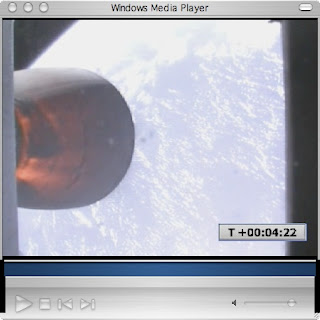
[update 9:16 CST] Elon says 90% of the objectives were met and the rocket reaches 300km. They will not need another test flight before launch a satellite later this year. Boo-Ya!
[update: 9:09 CST] According to Elon Musk, the second stage most likely re-entered atmosphere before entering orbit. It was still a good ride, though.
That was awesome. I watch from T-16 minutes without moving. It was like watching the Superbowl. It was up, the first stage fell away, the second engine started and the fairing fell away. It was unbelievable.
All I can say is thank God for the Internet and all the best to Elon Musk and SpaceX. This is the beginning of a new era in rocket launches.
Waiting to make sure everything ended OK. The Webcast cut off after the fairing separated.
Kimbal Musk has a photo:
SpaceX has Started Testing Falcon 9 Engines
SpaceX, who is set to launch the Falcon 1 tonight, has also started testing the engines for the Falcon 9.
SpaceX Falcon 1 Launch Set for Today
This from Elon:
The abort that occurred a few minutes before T-0 was triggered by our ground control software. It commanded a switchover of range telemetry from landline to radio, which took place correctly, however, because of the hardware involved, this transition takes a few hundred milliseconds. Before it had time to complete, our system verification software examined state and aborted.
Our simulations done beforehand all passed, because the simulator did not account for a hardware driven delay in the transition. We considered putting the vehicle into a safe state yesterday and updating the ground control software to make the very minor fix needed, but the safer course of action was to stand down.
Yesterday afternoon and evening (Kwaj time), our launch team updated the software to address the timing issue and verified that there were no similar problems elsewhere. We ran the software through several simulated countdowns and then once again with the rocket and range in the loop.
All systems are now go for launch with T-0 at 4pm California time today (Tues).
--Elon--
The Webcast is still set for T-1 hour (so 5:00 pm CST). Good luck to SpaceX!
The abort that occurred a few minutes before T-0 was triggered by our ground control software. It commanded a switchover of range telemetry from landline to radio, which took place correctly, however, because of the hardware involved, this transition takes a few hundred milliseconds. Before it had time to complete, our system verification software examined state and aborted.
Our simulations done beforehand all passed, because the simulator did not account for a hardware driven delay in the transition. We considered putting the vehicle into a safe state yesterday and updating the ground control software to make the very minor fix needed, but the safer course of action was to stand down.
Yesterday afternoon and evening (Kwaj time), our launch team updated the software to address the timing issue and verified that there were no similar problems elsewhere. We ran the software through several simulated countdowns and then once again with the rocket and range in the loop.
All systems are now go for launch with T-0 at 4pm California time today (Tues).
--Elon--
The Webcast is still set for T-1 hour (so 5:00 pm CST). Good luck to SpaceX!
Using Lasers to Detect and Deflect Asteroids
Researchers at the University of Alabama, Huntsville (my current school -djs) say a light-weight space based laser could detect near earth asteroids 10 times better than current radar techniques.
Short pulse lasers could also be used to move asteroids away from the Earth. Researchers say we are two decades away from technology maturity, however.
Short pulse lasers could also be used to move asteroids away from the Earth. Researchers say we are two decades away from technology maturity, however.
NASA Begins VodCasts
NASA, in an effort to appeal to a younger demographic, has started downloadable "vodcasts."
SpaceX Launch Scrubbed
If you were watching the webcast last night, you already know, the launch of the Falcon 1 was scrubbed due to a range telemetry problem problem. We will let you know the new launch time as soon as we do.
[Update 8:47am] MSNBC has more information.
[Update 8:47am] MSNBC has more information.
Monday, March 19, 2007
SpaceX Report
Kimbal Musk has an update on the static fire of SpaceX Falcon I at Kwajalein. Hopefully more will be coming as the launch time gets closer.
----
I guess I should post the time of the Launch :)
"The flight readiness review conducted tonight shows all systems are go for a launch attempt at 4pm California time (11pm GMT) tomorrow (Monday). The webcast can be seen at spacex.com/webcast.php and will start at T-60 minutes. Please check back for updates, as the launch will be postponed if we have even the tiniest concern."
----
I guess I should post the time of the Launch :)
"The flight readiness review conducted tonight shows all systems are go for a launch attempt at 4pm California time (11pm GMT) tomorrow (Monday). The webcast can be seen at spacex.com/webcast.php and will start at T-60 minutes. Please check back for updates, as the launch will be postponed if we have even the tiniest concern."
Saturday, March 17, 2007
SpaceX Launch-2 Update
From Elon:
March 17, 2007
DemoFlight 2 Update
At present, it appears that we are on track for a launch next week, possibly as soon as Monday. We had a very successful static fire yesterday that proceeded smoothly with no aborts.
Our initial review of the data showed that the rocket functioned almost perfectly. The only remaining concern is that the GPS portion of the guidance system showed an anomaly about 15 minutes *after* the static fire. Falcon 1 is designed to achieve its target orbit purely on inertial navigation, so the GPS, while helpful for improving orbit inseration accuracy, is not flight critical.
We are carefully analyzing the GPS and, more importantly, are making sure that the GPS problem does not hint at some larger issue. I will send out an update on Sunday confirming what day we will have our first countdown attempt. In the meantime, here are two videos of the static fire, one from a medium distance camera and one from a high speed close up camera. There will be a total of 12 cameras looking at the rocket on launch day, including two thermal imaging and two vehicle cams, so no shortage visual data.
I know it has been a year since our last launch and some people are wondering if launch 3 will also be a year away if something goes wrong this time. The answer is definitely no. The reason it took us a year is that the vehicle on the pad and the ground support equipment have hundreds of robustness upgrades -- this is really Falcon 1 version 2.
There is nothing significant that we can think of to improve the vehicles under construction for the Dept of Defense and Malaysian satellite launches later this year. Therefore, no matter what happens, I do not expect there to be a significant delay in their approximate end of summer and mid fall launch dates.
On a separate note, we have made tremendous progress with the Falcon 9 development and I'm way overdue in posting a big update on progress. Should have that out sometime next month. Between ramping up for NASA COTS and the F1 launch, time has been a little tight around here :)
The videos of the static fire can be seen at:
MEDIUM: http://www.spacex.com/00Graphics/Videos/StaticFire%20HD%202007-03-16.wmv
CLOSE: http://www.spacex.com/00Graphics/Videos/StaticFire%20HScam1%202007-03-16.wmv
---Elon
March 17, 2007
DemoFlight 2 Update
At present, it appears that we are on track for a launch next week, possibly as soon as Monday. We had a very successful static fire yesterday that proceeded smoothly with no aborts.
Our initial review of the data showed that the rocket functioned almost perfectly. The only remaining concern is that the GPS portion of the guidance system showed an anomaly about 15 minutes *after* the static fire. Falcon 1 is designed to achieve its target orbit purely on inertial navigation, so the GPS, while helpful for improving orbit inseration accuracy, is not flight critical.
We are carefully analyzing the GPS and, more importantly, are making sure that the GPS problem does not hint at some larger issue. I will send out an update on Sunday confirming what day we will have our first countdown attempt. In the meantime, here are two videos of the static fire, one from a medium distance camera and one from a high speed close up camera. There will be a total of 12 cameras looking at the rocket on launch day, including two thermal imaging and two vehicle cams, so no shortage visual data.
I know it has been a year since our last launch and some people are wondering if launch 3 will also be a year away if something goes wrong this time. The answer is definitely no. The reason it took us a year is that the vehicle on the pad and the ground support equipment have hundreds of robustness upgrades -- this is really Falcon 1 version 2.
There is nothing significant that we can think of to improve the vehicles under construction for the Dept of Defense and Malaysian satellite launches later this year. Therefore, no matter what happens, I do not expect there to be a significant delay in their approximate end of summer and mid fall launch dates.
On a separate note, we have made tremendous progress with the Falcon 9 development and I'm way overdue in posting a big update on progress. Should have that out sometime next month. Between ramping up for NASA COTS and the F1 launch, time has been a little tight around here :)
The videos of the static fire can be seen at:
MEDIUM: http://www.spacex.com/00Graphics/Videos/StaticFire%20HD%202007-03-16.wmv
CLOSE: http://www.spacex.com/00Graphics/Videos/StaticFire%20HScam1%202007-03-16.wmv
---Elon
Friday, March 16, 2007
Orbital Outpost vs. Lunar Outpost
Al Globus makes an argument that orbiting space colonies are better than lunar colonies. I agree with some of what he says, but he only shows one side of it.
His agreements amount to:
His agreements amount to:
- Orbital colonies are easier to build
- There's more space
- Orbital Colonists can live at 1 g.
To address point 3 first, there is little evidence of the effects of 1/6 g on the human body. So it is not a given that Lunnies could not visit Earth. But it might be a valid point.
Argument 2 is true, but I am not sure it matters. As he admits, the Earth is nearly uninhabited by area, so how are we going to fill up huge colonies in the near future, when we don't even fill up our home.
About point 1, he states:Getting back and forth to orbit is far easier than getting to the Moon or Mars, which is why we've had space stations circling Earth for thirty years and have yet to see the first base on the Moon much less on Mars.
First, we have not had large circling stations in orbit for any years. Skylab, Mir, and ISS together could hold maybe 20 people, if they liked each other. And they all cost a fortune to build. In orbit, everything you build has to come from somewhere else. On the Moon, it could (potentially) come from the dust beneath your feet.
I think it is yet to be seen whether orbital or lunar colonies will be better. Hopefully we will have both along with many other colonies on many other moons and planets in the coming centuries. I think I will lean on the side of the moon for our first foray.
NASA has a RFI for Space Communications Networks Services
This notice is issued by the NASA Goddard Space Flight Center (GSFC) to post a Request for Information (RFI) via the Internet, and solicit responses from interested parties in connection with an anticipated procurement for Space Communications Networks Services
Mike Griffin's Speech to Congress
Here is the transcript to Mike Griffin's speech to the Senate Appropriations Subcommittee on Commerce, Justice, Science, and Related Agencies on the 2008 NASA budget.
This was a nice tidbit:
In 1963, President Kennedy visited Redstone Arsenal in Huntsville, Alabama and posed the following question: "I know there are lots of people now who say, 'Why go any further in space?' When Columbus was halfway through his voyage, the same people said, 'Why go on any further? What will we possibly find? What good will it be?' And they want to stop now. I believe the United States of America is committed...to be first in space. And the only way we are going to be first in space is to work as hard as we can here and all across the country."
This was a nice tidbit:
In 1963, President Kennedy visited Redstone Arsenal in Huntsville, Alabama and posed the following question: "I know there are lots of people now who say, 'Why go any further in space?' When Columbus was halfway through his voyage, the same people said, 'Why go on any further? What will we possibly find? What good will it be?' And they want to stop now. I believe the United States of America is committed...to be first in space. And the only way we are going to be first in space is to work as hard as we can here and all across the country."
Mars Express Measures Water on Mar's
Mars Express has estimated the water trapped in Mar's south pole and it is the same amount as 11 meters (about 30 feet) deep across the planet.
Starsys Obrital Express Comming
Starsys, a subsidiary of SpaceDev, was responsible for the capture and separation of the Orbital Express system launch this month by DARPA and Boeing.
Thursday, March 15, 2007
300
If you haven't heard, 300 is the best movie I have seen since Serenity. Critics don't seem to like it, which is another good reason to go see it.
The Next Fifty Years
NASA Chief, Mike Griffin, has an article on what the next 50 years might hold for space travel. I am okay with most of what he says (not happy, but okay), but this truly scares me:
It is to be hoped and, I believe, expected that the next era of space exploration will be international in scope, in much the same fashion as the development of the International Space Station today. Whatever might be said of the ISS program – and there cannot be much that has been left unsaid – it has pioneered a path to the development of a major international space facility. There are lessons learned in so doing that we will take with us out into the Solar System. These lessons will be the most enduring, and ultimately most valuable, contribution the ISS can make. We will be applying them on Mars, fifty years from now. (emphasis mine)
Dear God. If the ISS is our model we are in trouble. I shutter to call the ISS a space facility, which implies it facilitates something. The ISS is the worst example of everything that is wrong with NASA.
If we use that model, the Lunar outpost Dr. Griffin speaks of, will be compromised to the point of uselessness. It will be a nightmare to change, and it will be impossible to ditch because we have "international commitments."
I admit, I am not a big fan of international cooperation in space. If we must, however, there has to be a better way than the ISS model.
It is to be hoped and, I believe, expected that the next era of space exploration will be international in scope, in much the same fashion as the development of the International Space Station today. Whatever might be said of the ISS program – and there cannot be much that has been left unsaid – it has pioneered a path to the development of a major international space facility. There are lessons learned in so doing that we will take with us out into the Solar System. These lessons will be the most enduring, and ultimately most valuable, contribution the ISS can make. We will be applying them on Mars, fifty years from now. (emphasis mine)
Dear God. If the ISS is our model we are in trouble. I shutter to call the ISS a space facility, which implies it facilitates something. The ISS is the worst example of everything that is wrong with NASA.
If we use that model, the Lunar outpost Dr. Griffin speaks of, will be compromised to the point of uselessness. It will be a nightmare to change, and it will be impossible to ditch because we have "international commitments."
I admit, I am not a big fan of international cooperation in space. If we must, however, there has to be a better way than the ISS model.
Tuesday, March 13, 2007
Shackleton Energy Company to Build Orbital Fueling Station
Dr. Bill Stone, of Stone Aerospace, has formed Shackleton Energy Company (SEC) to first be the first commercial venture to mine the Moon for fuel and setup orbital fuel depots. Dr. Stone says "once initial funding is received to initiate the detailed planning effort, we expect to be open for business in LEO in the 2015 timeframe."
Editorial: What is Really Imporant in Space
Clark Lindsey made a comment this morning about NASA and cost:
I think I know why NASA doesn't work on cost. Go with me for a moment.
In my day job as a software engineer for the Army, I work to integrate new products into Army air and missile defense systems. Each system is made up of functional and non-functional requirements. Functional requirements are the core job of the product. Non-functional requirements are physical realities, such as bandwidth, memory, size, weight, etc...
Engineers don't generally like non-functional requirements. They aren't fun. It was the nitty-gritty of the problem that drew them to be engineers in the first place. Reality isn’t sexy. So product teams continue on, making better algorithms and data structures, pushing off the inconvenient truths of the environment their product will have to operate in.
For instance, algorithms for integrating air tracks have been around for years. We can do SIAP (single integrated air picture) as long as we ignore reality (e.g. limited bandwidth in the field). The irony is whichever group solves SIAP over radios will win in the end. But that isn't sexy. So they continue on with better algorithms and unlimited bandwidth and zero latency. But when the rubber meets the road, there is no real product.
Okay, so what does that have to do with NASA? Non-functional requirements, while never sexy, are usually at least as important as functional requirements and harder to solve. Cost is a non-functional requirement for NASA.
Making space crafts cheaper isn't what engineers at NASA want to do. That isn’t why they went to school. They want to make new spacecraft with new materials and propulsion systems. And in the world of non-functional requirements that rarely translates to cheaper.
What makes spaceflight cheaper is reuse of existing products as much as possible and putting the engineering effort into the infrastructure in space. Fuel depots, for instance, could result in a long term reduction in the cost for Lunar trips. Even ignoring “New Space” ideas, believe it would have been cheaper for NASA to adapt the existing EELVs to use to go back to the Moon.
None of this is as sexy as designing a new rocket, though. But consider how much money Boeing would make if every time they got a new order for a jet, they designed and built a brand-new airplane. It wouldn’t be very cost effective. Instead, they continuously look for ways to improve their existing aircraft, opting to design a new model when the market requires it.
If NASA is going to ever reduce the price of their space activities, they are going to have to use what they have first. I do not believe the current goal of NASA requires a new series of rockets and spacecrafts.
But what do I know, I am just an engineer.
Cost is the great and overriding barrier both to space development and to renewed public interest in space. The growing interest and excitement about the nascent commercial spaceflight industry is based on its promise of significantly lower costs and in giving the public a chance to participate in spaceflight, or at least allowing them to identify with those who do. As long as NASA refuses to make reduction of the cost of spaceflight its primary goal, the agency's hyper-expensive programs will continue to be ignored by most of the public.
I think I know why NASA doesn't work on cost. Go with me for a moment.
In my day job as a software engineer for the Army, I work to integrate new products into Army air and missile defense systems. Each system is made up of functional and non-functional requirements. Functional requirements are the core job of the product. Non-functional requirements are physical realities, such as bandwidth, memory, size, weight, etc...
Engineers don't generally like non-functional requirements. They aren't fun. It was the nitty-gritty of the problem that drew them to be engineers in the first place. Reality isn’t sexy. So product teams continue on, making better algorithms and data structures, pushing off the inconvenient truths of the environment their product will have to operate in.
For instance, algorithms for integrating air tracks have been around for years. We can do SIAP (single integrated air picture) as long as we ignore reality (e.g. limited bandwidth in the field). The irony is whichever group solves SIAP over radios will win in the end. But that isn't sexy. So they continue on with better algorithms and unlimited bandwidth and zero latency. But when the rubber meets the road, there is no real product.
Okay, so what does that have to do with NASA? Non-functional requirements, while never sexy, are usually at least as important as functional requirements and harder to solve. Cost is a non-functional requirement for NASA.
Making space crafts cheaper isn't what engineers at NASA want to do. That isn’t why they went to school. They want to make new spacecraft with new materials and propulsion systems. And in the world of non-functional requirements that rarely translates to cheaper.
What makes spaceflight cheaper is reuse of existing products as much as possible and putting the engineering effort into the infrastructure in space. Fuel depots, for instance, could result in a long term reduction in the cost for Lunar trips. Even ignoring “New Space” ideas, believe it would have been cheaper for NASA to adapt the existing EELVs to use to go back to the Moon.
None of this is as sexy as designing a new rocket, though. But consider how much money Boeing would make if every time they got a new order for a jet, they designed and built a brand-new airplane. It wouldn’t be very cost effective. Instead, they continuously look for ways to improve their existing aircraft, opting to design a new model when the market requires it.
If NASA is going to ever reduce the price of their space activities, they are going to have to use what they have first. I do not believe the current goal of NASA requires a new series of rockets and spacecrafts.
But what do I know, I am just an engineer.
Japanese ISS Module is in Cape Canaveral
A Japanese built ISS module has arrived at NASA's Kennedy Space Center. The module is called Kibo and is Japan's first human space module. It is a three segment experiment module and Japan's largest contribution to the ISS.
Frontier Technologies
Alan Boyle has five frontier technologies he thinks we will see by 2012. One of those is private spaceflight:
5. Commercial spaceflight: I’ve been covering this field for about 10 years, and one of the high points came in 2004, when a privately developed rocket plane called SpaceShipOne made not just one, but three flights to the edge of outer space. I talked about the impact of those flights on the field of space tourism in a video clip from October 4, 2004, the date of SpaceShipOne’s final flight to the final frontier.
The successor to SpaceShipOne is expected to roll out for testing later this year, leading up to the start of commercial service two years from now. And SpaceShipTwo probably won’t be the only suborbital spaceship out there. By 2010, there might well be two or three companies offering quick rides to outer space and back, with a price tag of $200,000 or so. And that price tag is certain to go down as the industry matures.
A Nevada company called Bigelow Aerospace has already launched one unmanned orbital spaceship called Genesis 1, and the company is planning to put up a bigger ship that could serve as an orbiting hotel or research station in the 2010 time frame.
Bigelow Aerospace is backed by a real-estate billionaire named Robert Bigelow – who has set aside half a billion dollars to get his orbital venture off the ground. Last month, Bigelow told me that in 2012 or so, he’s planning to start focusing on helping NASA build its first moonbase. Bigelow is promising to make yet another big announcement next month, so you’ll have to stay tuned for the next chapter.
5. Commercial spaceflight: I’ve been covering this field for about 10 years, and one of the high points came in 2004, when a privately developed rocket plane called SpaceShipOne made not just one, but three flights to the edge of outer space. I talked about the impact of those flights on the field of space tourism in a video clip from October 4, 2004, the date of SpaceShipOne’s final flight to the final frontier.
The successor to SpaceShipOne is expected to roll out for testing later this year, leading up to the start of commercial service two years from now. And SpaceShipTwo probably won’t be the only suborbital spaceship out there. By 2010, there might well be two or three companies offering quick rides to outer space and back, with a price tag of $200,000 or so. And that price tag is certain to go down as the industry matures.
A Nevada company called Bigelow Aerospace has already launched one unmanned orbital spaceship called Genesis 1, and the company is planning to put up a bigger ship that could serve as an orbiting hotel or research station in the 2010 time frame.
Bigelow Aerospace is backed by a real-estate billionaire named Robert Bigelow – who has set aside half a billion dollars to get his orbital venture off the ground. Last month, Bigelow told me that in 2012 or so, he’s planning to start focusing on helping NASA build its first moonbase. Bigelow is promising to make yet another big announcement next month, so you’ll have to stay tuned for the next chapter.
Europe Launches British and Indian Satellites
An Ariane-5 ECA rocket launched a British Skynet 5A military satellite and an Indian Insat 4B civil communications satellite into orbit.
Monday, March 12, 2007
SpaceX Web Site
I'm am sure I am late on this, but SpaceX has a nifty new web-site. Remember their second launch attempt is next week (March 19 - 22).
China Planes an X-Ray Observatory in Space
China announced plans to build a Hard X-Ray modulation telescope in 2010.
They will also join Russia's project to send an unmanned probe to Mar's moon in 2009.
They will also join Russia's project to send an unmanned probe to Mar's moon in 2009.
New Space Education
Duncan Law-Green is promoting New Space education. That is something we all should work on.
In Orbit Refueling
U.S. Air Force’s Space Technology Program 1 (STP-1) mission has launch two satellites to test in-orbit satellite refueling. If successful, this could go a long way in developing orbital refueling depots for spacecraft.
Good and Bad News about Killer Asteroids
A new report says a chances of a large "planet killer" asteroid impacting the Earth are smaller than previously thought. That is Good news.
However, the chances of a smaller "city killer" are higher. That is bad news, especially if it is your city.
To bad nobody is taking the point on figuring out a way to prevent this.
However, the chances of a smaller "city killer" are higher. That is bad news, especially if it is your city.
To bad nobody is taking the point on figuring out a way to prevent this.
Shuttle Tank Can be Fixed
According to NASA, the External Tank, or ET, that was damaged in a hail storm can be fixed. This is good news since replacing the tank would have pushed the launch window even further than April. possibly to June. The original launch date was March 15.
This will be the first launch of the year. NASA hopes to launch four to five time this year to hold to the 2010 retirement date of the shuttle.
This will be the first launch of the year. NASA hopes to launch four to five time this year to hold to the 2010 retirement date of the shuttle.
Lis Nowak Fired
You know things are bad when NASA shows up in the Celebrity Cafe. Lisa Nowak was fired and sent back to the Navy and Corpus Christi, Texas.
Reminder of SpaceX Test Fire Next Week
SpaceX will hold a static fire this week, with a launch window of March 19-22. Good luck from all of us at Space Pragmatism!
Thursday, March 08, 2007
War In Heaven
In "War in Heaven," a Nobel Prize-nominated peace activist and a former U.S. foreign service officer (who helped write the Outer Space Treaty of 1967) look at the history of military uses of space and the current plans for "weaponizing the heavens," including kinetic, laser, nuclear bombardment, and anti-satellite weapons. Contrary to the claims of Secretary of Defense Donald Rumsfeld that the United States faces a "space Pearl Harbor," Caldicott and Eisendrath show that the United States itself is today the principal obstruction to passage of an international treaty banning weapons from outer space. At a time when plans to build and deploy space weapons are on the administration's agenda but only just becoming known to the general public, this book will help launch a national discussion of a critical issue.
Caldicott and Eisendrath are both available for interviews about the book throughout the spring.
Speaking engagements include:
-- Regina, Canada - March 6, 2007 at University of Regina
-- Saskatoon, Canada - March 7, 2007 at 304 3rd Avenue North
-- Baltimore, MD - March 14, 2007 12 noon - Community College of Baltimore
County - Essex Campus
-- Washington, DC - March 18, 2007 at 6:30 p.m. - Busboys & Poets
-- Chicago, IL - March 21 & 22, 2007 at Loyola University
-- Washington, DC - March 28, 2007 at Beyond Nuclear Weapons Conference at
the National Press Club
More information about all engagements is available at http://www.nuclearpolicy.org/ or by calling 202/822-9800.
"War In Heaven" is being published by the New Press in New York. It retails for $23.95.
Caldicott and Eisendrath are both available for interviews about the book throughout the spring.
Speaking engagements include:
-- Regina, Canada - March 6, 2007 at University of Regina
-- Saskatoon, Canada - March 7, 2007 at 304 3rd Avenue North
-- Baltimore, MD - March 14, 2007 12 noon - Community College of Baltimore
County - Essex Campus
-- Washington, DC - March 18, 2007 at 6:30 p.m. - Busboys & Poets
-- Chicago, IL - March 21 & 22, 2007 at Loyola University
-- Washington, DC - March 28, 2007 at Beyond Nuclear Weapons Conference at
the National Press Club
More information about all engagements is available at http://www.nuclearpolicy.org/ or by calling 202/822-9800.
"War In Heaven" is being published by the New Press in New York. It retails for $23.95.
NASA to Announce Winner of Space Station Student Naming Contest
From PR News-wire:
NASA's newest module for the International Space Station is about to be given a new name. NASA's Kennedy Space Center hosts a media event on Thursday, March 15, at noon EDT to unveil the Node 2 module's new name.
The name was chosen from an academic competition involving thousands of students in kindergarten through high school. The Node 2 Challenge required students to learn about the International Space Station, build a scale model of the module, and write an essay explaining their proposed name. This will be the first U.S. piece of the space station named by someone other than a NASA official.
Media planning to attend the event should arrive at Kennedy's Press Site by 11 a.m. for transportation to the Space Station Processing Facility. Node 2 is being prepared there for its space shuttle Atlantis flight, designated STS- 120, which is targeted for launch later this year. Media without permanent Kennedy credentials should submit their request online at:
http://www.nasa.gov/ntv
Node 2 is a pressurized module that will act as a connecting port and passageway to additional international science labs and supply spacecraft. It also will be a work platform for the station's robotic arm. For more information on the station and Node 2, visit:
http://www.nasa.gov/station
Contact: Allard Beutel, Headquarters, Washington, +1-202-358-4769, or Tracy Young, Kennedy Space Center, Florida, +1-321-867-2468, both of NASA
NASA's newest module for the International Space Station is about to be given a new name. NASA's Kennedy Space Center hosts a media event on Thursday, March 15, at noon EDT to unveil the Node 2 module's new name.
The name was chosen from an academic competition involving thousands of students in kindergarten through high school. The Node 2 Challenge required students to learn about the International Space Station, build a scale model of the module, and write an essay explaining their proposed name. This will be the first U.S. piece of the space station named by someone other than a NASA official.
Media planning to attend the event should arrive at Kennedy's Press Site by 11 a.m. for transportation to the Space Station Processing Facility. Node 2 is being prepared there for its space shuttle Atlantis flight, designated STS- 120, which is targeted for launch later this year. Media without permanent Kennedy credentials should submit their request online at:
http://www.nasa.gov/ntv
Node 2 is a pressurized module that will act as a connecting port and passageway to additional international science labs and supply spacecraft. It also will be a work platform for the station's robotic arm. For more information on the station and Node 2, visit:
http://www.nasa.gov/station
Contact: Allard Beutel, Headquarters, Washington, +1-202-358-4769, or Tracy Young, Kennedy Space Center, Florida, +1-321-867-2468, both of NASA
Pluto is a Planet in New Mexico
The New Mexico State Legislature has declared Pluto to be planet and instituted a Pluto day on March 13 (the date of the Pluto's announcement by the IAU in 1930).
"NOW, THEREFORE, BE IT RESOLVED BY THE LEGISLATURE OF THE STATE OF NEW MEXICO that, as Pluto passes overhead through New Mexico's excellent night skies, it be declared a planet and that March 13, 2007 be declared "Pluto Planet Day" at the legislature."
"NOW, THEREFORE, BE IT RESOLVED BY THE LEGISLATURE OF THE STATE OF NEW MEXICO that, as Pluto passes overhead through New Mexico's excellent night skies, it be declared a planet and that March 13, 2007 be declared "Pluto Planet Day" at the legislature."
Wednesday, March 07, 2007
Interview With Jim Benson
Space Liberates Us has an interview with Jim Benson, CEO of Benson Space Company and former CEO of SpaceDev.
He plans for flight testing all through 2008.
He plans for flight testing all through 2008.
China will Launch a Moon Probe this Year
China has confirmed they will launch a probe to the Moon this year. They also expect to land a man on the Moon in 15 years (or 2022).
ISU to be Hosted at the ARC
NASA's ARC will host 2009 ISU summer session. I have head it is a great program if anyone gets a chance to go.
NASA Completes the Orion Requirements
NASA has baselined the Orion requirements. There are over "1,700 topics covering all aspects of vehicle performance, design and qualification were discussed during the course of the formal review. "
Talk about over management. Don't get me wrong, I have worked on many government requirements reviews and I am not surprised by this. I also know that each of these requirements will translate into three or four system and sub-system level requirements when they hit the contractors.
And of course they won't pay attention to them until it is time to do formal testing. It is a cycle of death.
There is really only one real requirement,
Carry 6 astronauts to the Moon and back many times. Try not to kill them.
Of course that's just me.
Talk about over management. Don't get me wrong, I have worked on many government requirements reviews and I am not surprised by this. I also know that each of these requirements will translate into three or four system and sub-system level requirements when they hit the contractors.
And of course they won't pay attention to them until it is time to do formal testing. It is a cycle of death.
There is really only one real requirement,
Carry 6 astronauts to the Moon and back many times. Try not to kill them.
Of course that's just me.
Virginia Governor Set to Review Space Bill
From spaceport.blogspot.com:
Tim Kaine, Virginia Governor, is set to review House Bill 3184 this week. This bill would limit liability for commercial human spaceflight in Virginia. It is the first of its kind in the US and give a big boost to the emerging Mid-Atlantic Regional Spaceport.
He has until April 4 to take action on the bill.
Tim Kaine, Virginia Governor, is set to review House Bill 3184 this week. This bill would limit liability for commercial human spaceflight in Virginia. It is the first of its kind in the US and give a big boost to the emerging Mid-Atlantic Regional Spaceport.
He has until April 4 to take action on the bill.
Tuesday, March 06, 2007
Next Space Tourist to use Amateur Radio
Charles Simonyi, the next space tourist to the ISS, is going to talk with three schools over amateur radio. He is KE7KDP, for those HAM guys out there. You know who you are.
Eric Anderson on Space Tourism in the Gulf
In an article in ArabBusiness.com, Eric Anderson, President of Space Adventures, talks about the coming spaceports in the UAE and Qatar. He also seems confident they will have a sub-orbital vehicle in the "next few years."
It has been reported, however, that the Russians may not be developing the Explorer suborbital craft after all. So is Mr. Anderson still hoping the Russians will come through or is he shopping for another suborbital vehicle.
I did like this comment:
While flight prices may sound astronomical at the moment however, Anderson claims that prices will be “affordable to the tens of thousands level in the next 10 to 15 years.”
It has been reported, however, that the Russians may not be developing the Explorer suborbital craft after all. So is Mr. Anderson still hoping the Russians will come through or is he shopping for another suborbital vehicle.
I did like this comment:
While flight prices may sound astronomical at the moment however, Anderson claims that prices will be “affordable to the tens of thousands level in the next 10 to 15 years.”
More Information on the Dream Chaser
Jim Benson was interviewed by the Space Show Sunday. He talked about the Dream Chaser project his company, Benson Space, is working on. Clark Lindsey has more.
Monday, March 05, 2007
SpaceX Falcon Launch Update
Upate from Elon Musk:
DemoFlight 2 Launch Update
The launch window is now March 19th to 22nd (California time). During extended ground testing in late February, one of our second stage thrust vector control boards indicated a problem. Although our analysis showed substantial margin for flight, we decided nonetheless to increase the robustness of certain of the components and run a delta qualification.
The upgraded boards will be installed this week. If all goes well, Falcon 1 will do a static fire next week and then launch in the week of the 19th
---Elon
DemoFlight 2 Launch Update
The launch window is now March 19th to 22nd (California time). During extended ground testing in late February, one of our second stage thrust vector control boards indicated a problem. Although our analysis showed substantial margin for flight, we decided nonetheless to increase the robustness of certain of the components and run a delta qualification.
The upgraded boards will be installed this week. If all goes well, Falcon 1 will do a static fire next week and then launch in the week of the 19th
---Elon
Not Enough Money to Save Us from Asteriods
NASA says, while they have enough money to find and monitor near Earth asteroids capable of killing us, they don't have the funds to do anything about it.
Does this bother anyone else?
Does this bother anyone else?
Information on Bigelow's Genesis 2
Bigelow Aerospace has an article, showing the differences in the Genesis 1 and Genesis 2. Genesis 1 is currently orbiting the Earth and the Genesis 2 is set to be launched in April.
To Summarize:
To Summarize:
- Improvements on the materials used in the construction of the inflatable modules
- Upgrades in the control and sensory equipment (so better pictures?)
- Tripled data rates (with Alaska and Hawaii ground sites) with a comm window of 5 hours/day
- Increased communications results in better vision systems (so better pictures?) plus outside cameras showing a better view of the module in space
- Additional pressure, temperature, attitude control and radiation detection sensors
- Multi-tank inflation system
- More refined pointing control and a faster dampening of the initial tip-off rate or body rotation from rocket separation
Report on the NSS Space Blitz 2007
Here is a report on the recent Space Blitz by the National Space Society.
Atlas Launch Tonight
There is a night launch of an Atlas tonight. The launch is of a STP-1, an Air Force program to launch 7 separate satellites and test the Orbital Express in-space refueling system.
China Plans a Spacewalk in 2008
They are moving right along in space, aren't they?
A Chinese Tychonaut to Walk in Space in 2008.
Here is more from the AP.
A Chinese Tychonaut to Walk in Space in 2008.
Here is more from the AP.
Space Review is Out
New Space Review:
Death throes and grand delusions
If you believe the Russian space company Energia, it has grand plans to industrialize the Moon and harvest helium-3. Such statements, Dwayne Day argues, are symptoms of deeper problems with both the company and Russian space policy.Monday, March 5, 2007
Current issues in NewSpace
Many of the concerns facing the entrepreneurial space industry have shifted over the years as markets have emerged and regulatory barriers overcome. Jeff Foust reports on what those in the industry see as some of the key issues now facing emerging space companies.Monday, March 5, 2007
So that’s what they mean by sustainable and affordable
Recent documents suggest that NASA is planning to launch only a couple Orion spacecraft a year for the indefinite future. Taylor Dinerman argues that this makes international and commercial partners critical to the long-term success of the Vision.Monday, March 5, 2007
Space program co-ops and Astronaut Farmer
In a movie, Charles Farmer assembles an orbital rocket in his barn to fulfill a lifelong dream. Sam Dinkin reviews the real-life history of personal efforts to go to space.Monday, March 5, 2007
A plea to those who are passionate about human spaceflight
It’s one thing to say that the space community needs to educate and reach out to the public. However, Chris Carberry says that the community itself needs to do more political work to ensure a bright future for space exploration.Monday, March 5, 2007
Death throes and grand delusions
If you believe the Russian space company Energia, it has grand plans to industrialize the Moon and harvest helium-3. Such statements, Dwayne Day argues, are symptoms of deeper problems with both the company and Russian space policy.Monday, March 5, 2007
Current issues in NewSpace
Many of the concerns facing the entrepreneurial space industry have shifted over the years as markets have emerged and regulatory barriers overcome. Jeff Foust reports on what those in the industry see as some of the key issues now facing emerging space companies.Monday, March 5, 2007
So that’s what they mean by sustainable and affordable
Recent documents suggest that NASA is planning to launch only a couple Orion spacecraft a year for the indefinite future. Taylor Dinerman argues that this makes international and commercial partners critical to the long-term success of the Vision.Monday, March 5, 2007
Space program co-ops and Astronaut Farmer
In a movie, Charles Farmer assembles an orbital rocket in his barn to fulfill a lifelong dream. Sam Dinkin reviews the real-life history of personal efforts to go to space.Monday, March 5, 2007
A plea to those who are passionate about human spaceflight
It’s one thing to say that the space community needs to educate and reach out to the public. However, Chris Carberry says that the community itself needs to do more political work to ensure a bright future for space exploration.Monday, March 5, 2007
Bigelow Genesis 2 launch
According to Roscosmos schedule, the Genesis 2 will launch on April 26, 2007.
(hat tip to RVL and Space Transport News.)
(hat tip to RVL and Space Transport News.)
China Increases Military Spending 17.8%
China is increasing their military budget by 17.8% to about $45 billion. While that is a fraction of the US military budget, experts believe that most of China's military budget is not part of the public budget. After setting of an ASAT test last month, China has been the focus of discussion over a space arms race.

Sunday, March 04, 2007
March Storm 2007
March Storm, the ProSpace assault on the Capital Hill, starts this week. The agenda includes spaceport and prizes. Jeff Foust at Space Politics has more.
Saturday, March 03, 2007
Lisa Nowak Charged with Kidnapping
Lisa Nowak, NASA Astronaut, has been charged with kidnapping a love rival. The D.A. is not charging her with attempted murder.
Oldest Solar Observatory Found
A 2300 year old solar observatory was found in coastal Peru by archaeologists.
Lunar Eclipse Tonight

There will be a total lunar eclipse tonight. It begins at about 6:00pm EST, so those of use in the eastern US will only catch the tail-end of it.
The moon will already be partially cover when it rises tonight in the eastern US, but it is still not to be missed.
The moon will already be partially cover when it rises tonight in the eastern US, but it is still not to be missed.
Friday, March 02, 2007
SS2 Video Update
Moonspace Dreams has the Youtube version of the SS2 video I posted the other day. It is the full length version.
Why the Moon is Worth It?
Charles Krauthammer as an editorial at the Washington Post titled Music Of the Spheres Why a Moon Mission Is Worth the Money.
His basic premise is that our manned space program for the last 30 years has been useless. He puts it as, "[t]here's nothing quite as beautiful as the space station and the shuttle that services it, and nothing quite as useless."
He believes the Moon is useful since it is a "The moon is a destination. The idea this time is not to go to plant a flag, take a golf shot and leave, but to stay and form a real self-sustaining, extraterrestrial human colony."
He also points out that, "Humans can discover things through intuition and pattern recognition that machines thinking in algorithms cannot. Imagine the scientific possibilities if today we had humans patrolling Mars rather than the brilliantly programmed but still limited golf carts now roaming the surface."
Can't argue with it.
His basic premise is that our manned space program for the last 30 years has been useless. He puts it as, "[t]here's nothing quite as beautiful as the space station and the shuttle that services it, and nothing quite as useless."
He believes the Moon is useful since it is a "The moon is a destination. The idea this time is not to go to plant a flag, take a golf shot and leave, but to stay and form a real self-sustaining, extraterrestrial human colony."
He also points out that, "Humans can discover things through intuition and pattern recognition that machines thinking in algorithms cannot. Imagine the scientific possibilities if today we had humans patrolling Mars rather than the brilliantly programmed but still limited golf carts now roaming the surface."
Can't argue with it.
Discussions on Orbiting Fuel Depots
Dallas Bienhoff of Boeing was on the Space Show recently talking about Orbiting Fuel Depots. Jon Goff expands on his ideas.
It wouldn't just help NASA, though. With Bigelow's plan to build a construction site at the L-1 point, they are going to need propellant depots that are easy to get to. I think if NASA or private companies plan on putting fuel depots up, they need to consider the best places to put it.
It wouldn't just help NASA, though. With Bigelow's plan to build a construction site at the L-1 point, they are going to need propellant depots that are easy to get to. I think if NASA or private companies plan on putting fuel depots up, they need to consider the best places to put it.
Moon Hardware Presenation
The Lunar Landar Project Office presented this on hardware for the return to the Moon. It was briefed at the AIAA dinner on February 22.
Orion Contract Turmoil
Given the history of the contract and the length (until 2019), the GAO wants NASA to reconsider its decision to give the second part of the Orion contract to Lockheed last September. GAO doesn't think NASA did enough research to award a 13 year contract.
Under Sean O'Keefe, the plan was to have a fly-off between the competitors. When Griffin took over, they redesigned to architecture closer to Apollo and decided to go ahead an award the contract.
Under Sean O'Keefe, the plan was to have a fly-off between the competitors. When Griffin took over, they redesigned to architecture closer to Apollo and decided to go ahead an award the contract.
Thursday, March 01, 2007
Ares & Orion Delayed until 2015
According to NASA Chief Mike Griffin the development schedule of the Ares rocket and the Orion space craft will slip 4-6 months pushing it into 2015. This is at least partly due to exploration budget reductions for 2007 of more than $900 million. However, there is some reports that both the Ares and Orion programs are already missing schedule targets before the 2007 budget came out.
The Shuttle is set to retire in 2010, so this leave NASA without it's own space vehicle for up to five years. Either the COTS program of Russia will be the only way for NASA to get into space for that time period.
Here is the transcript of Dr. Griffin's speech to Senate Committee on Commerce, Science and Transportation Subcommittee on Space, Aeronautics and Related Sciences.
Space Today has more.
The Shuttle is set to retire in 2010, so this leave NASA without it's own space vehicle for up to five years. Either the COTS program of Russia will be the only way for NASA to get into space for that time period.
Here is the transcript of Dr. Griffin's speech to Senate Committee on Commerce, Science and Transportation Subcommittee on Space, Aeronautics and Related Sciences.
Space Today has more.
Stephen Hawking to take a Zero-G Flight
If anyone deserves it...
Zero Gravity Corporation (ZERO-G(R)), announced today that Prof. Stephen Hawking, the world renowned physicist and expert on gravity, will fly weightless on The ZERO-G Experience(TM) on April 26, 2007. The flight will take off from the Shuttle Landing Facility at the Kennedy Space Center in Central Florida.
Prof. Hawking's best selling books, "A Brief History of Time" and "Black Holes and Baby Universes and Other Essays" examines the basic laws, history and future of the universe. Hawking is known for his contributions to the fields of cosmology and quantum gravity, especially in the context of black holes. He has also made public his interest in experiencing weightlessness, and the importance of space as the next frontier for human population.
"As someone who has studied gravity and black holes all of my life, I am excited to experience, first hand, weightlessness and a zero-gravity environment," said Prof. Hawking. "I am thankful to Zero Gravity Corporation for making this experience available to the general public, especially for disabled individuals."
"It is truly an honor to have Prof. Stephen Hawking aboard The ZERO-G Experience(TM)," stated Dr. Peter H. Diamandis, CEO and Co-Founder of ZERO-G. "Our mission is to make the excitement and adventure of space and weightlessness accessible and enjoyable. Flying Prof. Hawking helps us demonstrate how this unique experience, once available only to astronauts, is now available to everyone."
The Hawking flight has been organized for a number of reasons, including as a benefit for several charitable organizations including Easter Seals (www.easterseals.com); the Starlight Starbright Children's Foundation (www.starlight.org); the X PRIZE Foundation (xprize.org) and Augie's Quest (www.augiesquest.org). Each of these groups will be given two seats aboard the flight to auction off.
Space Florida, the organization charged with promoting commercial space in the state of Florida, has come aboard as a sponsor of the flight. "We are excited and proud to have Professor Hawking fly from the Kennedy Space Center aboard a Florida-based commercial carrier," said Steve Kohler, Executive Director of the Space Florida.
The ZERO-G Experience consists of a brief training session for flyers (ZERO-G passengers) followed by a 90-minute flight aboard G-Force One, during which parabolic maneuvers are performed. The controlled ascent and descent of the plane allows flyers to experience gravity on Mars (1/3-gravity); the moon (1/6-gravity); and in zero-g space. Since launching its service to the general public in September 2004, the company has conducted more than 100 weightless flights and flown more than 2,500 passengers, including celebrities and personalities, corporate charters, science and math teachers, and individuals age 12 to 85.
G-Force One is a specially-modified, 35-passenger Boeing 727-200, and The ZERO-G Experience(TM) is the only FAA-approved weightless flight experience available to the general public. The weightless flights are similar to those conducted by NASA for more than 40 years to train its astronauts. ZERO-G was recently granted FAA approval to fly individuals with disabilities. ZERO-G operates under the highest safety standards as set by the FAA (Part-121) with its partner Amerijet International. Aircraft operations take place under the same regulations set for commercial passenger airlines.
Zero Gravity Corporation (ZERO-G(R)), announced today that Prof. Stephen Hawking, the world renowned physicist and expert on gravity, will fly weightless on The ZERO-G Experience(TM) on April 26, 2007. The flight will take off from the Shuttle Landing Facility at the Kennedy Space Center in Central Florida.
Prof. Hawking's best selling books, "A Brief History of Time" and "Black Holes and Baby Universes and Other Essays" examines the basic laws, history and future of the universe. Hawking is known for his contributions to the fields of cosmology and quantum gravity, especially in the context of black holes. He has also made public his interest in experiencing weightlessness, and the importance of space as the next frontier for human population.
"As someone who has studied gravity and black holes all of my life, I am excited to experience, first hand, weightlessness and a zero-gravity environment," said Prof. Hawking. "I am thankful to Zero Gravity Corporation for making this experience available to the general public, especially for disabled individuals."
"It is truly an honor to have Prof. Stephen Hawking aboard The ZERO-G Experience(TM)," stated Dr. Peter H. Diamandis, CEO and Co-Founder of ZERO-G. "Our mission is to make the excitement and adventure of space and weightlessness accessible and enjoyable. Flying Prof. Hawking helps us demonstrate how this unique experience, once available only to astronauts, is now available to everyone."
The Hawking flight has been organized for a number of reasons, including as a benefit for several charitable organizations including Easter Seals (www.easterseals.com); the Starlight Starbright Children's Foundation (www.starlight.org); the X PRIZE Foundation (xprize.org) and Augie's Quest (www.augiesquest.org). Each of these groups will be given two seats aboard the flight to auction off.
Space Florida, the organization charged with promoting commercial space in the state of Florida, has come aboard as a sponsor of the flight. "We are excited and proud to have Professor Hawking fly from the Kennedy Space Center aboard a Florida-based commercial carrier," said Steve Kohler, Executive Director of the Space Florida.
The ZERO-G Experience consists of a brief training session for flyers (ZERO-G passengers) followed by a 90-minute flight aboard G-Force One, during which parabolic maneuvers are performed. The controlled ascent and descent of the plane allows flyers to experience gravity on Mars (1/3-gravity); the moon (1/6-gravity); and in zero-g space. Since launching its service to the general public in September 2004, the company has conducted more than 100 weightless flights and flown more than 2,500 passengers, including celebrities and personalities, corporate charters, science and math teachers, and individuals age 12 to 85.
G-Force One is a specially-modified, 35-passenger Boeing 727-200, and The ZERO-G Experience(TM) is the only FAA-approved weightless flight experience available to the general public. The weightless flights are similar to those conducted by NASA for more than 40 years to train its astronauts. ZERO-G was recently granted FAA approval to fly individuals with disabilities. ZERO-G operates under the highest safety standards as set by the FAA (Part-121) with its partner Amerijet International. Aircraft operations take place under the same regulations set for commercial passenger airlines.